

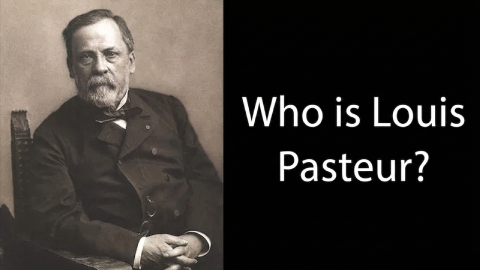
Louis Pasteur is a French chemist and microbiologist known for his extraordinary contributions to the world of science. Born in the town of Dole, France, in 1822, Pasteur was the child of a modest family. From a young age, his interest in science was remarkable. However, what made his story unique was his scientific curiosity and his deep sense of responsibility toward humanity.
Early Scientific Career and the Discovery of Crystals
Pasteur began his scientific career by studying the structure of crystals. In 1848, he discovered that certain crystals refracted light in different directions. This discovery not only laid the foundations of stereochemistry but also brought recognition to Pasteur in the scientific world. However, Pasteur’s greatest achievements came with his work on microorganisms.
Challenging Misconceptions: The Germ Theory
In the middle of the 19th century, there were many misconceptions about the origin of diseases. Pasteur put forward the idea that microorganisms could cause diseases and began working to prove it.
- 1857 Discovery: He discovered that fermentation was carried out by microorganisms.
- Scientific Impact: This discovery was an important step supporting the microbial origin of diseases, later known as the “germ theory.”
Louis Pasteur and Pasteurization
Pasteur’s best-known work is the “pasteurization” process that bears his name. He developed a mild heating method to destroy microorganisms found in foods such as raw milk and wine. This discovery revolutionized food safety and became an important step in protecting public health.
“Fortune Favors the Prepared Mind”: The Path to Vaccines
Pasteur summarized his meticulousness in scientific discoveries with his famous quote: “Fortune favors only the prepared mind.”
This approach allowed him to notice that a weakened bacterial culture provided immunity during his studies on chicken cholera by chance. This situation enabled him to lay the foundation for modern vaccine development methods and start a new era in the fight against diseases.
A Medical Revolution: The Rabies Vaccine
Pasteur carried out revolutionary studies not only in the field of food safety but also in the medical world. In 1885, he administered the rabies vaccine to a young boy named Joseph Meister and saved the boy’s life. This was the first successful rabies vaccine in history. It went down in history as one of Pasteur’s immense contributions to humanity.
The Pasteur Institute: A Living Legacy
In order to ensure the continuity of his scientific work, he founded the Pasteur Institute in Paris in 1887. This institution continued its activities as a global center in the field of infectious diseases and immunology even after his death. The Institute is considered the strongest representative of Pasteur’s scientific discipline and investigative spirit today.
Louis Pasteur’s Contributions to Humanity
Pasteur was not only a pioneer of scientific revolutions but also a scientist who aimed to serve humanity through his work.
- Health as a Priority: He viewed science as a tool to protect and improve human health.
- From Theory to Practice: His studies did not remain only as scientific discoveries but also turned into practical applications that saved the lives of millions of people.
An Enduring Legacy
When Louis Pasteur passed away at the age of 73 in 1895, he left indelible marks in human history behind him. His legacy continues to live as a symbol of the effort to make life on earth safer and healthier using the scientific method. Pasteur’s story is an inspiring example showing what can be achieved when scientific discoveries are combined with a mission to serve humanity.





Discover Dispatcharr: The Ultimate Open-Source IPTV and EPG Management Powerhouse
What is HAARP? Artificial Earthquakes Tesla’s Mysterious Legacy
Alibaba Issues Notice: Full Ban on All Anthropic Claude Series Models and Claude Code Programming Agent Effective July 10
OpenSquilla 0.4.0 Released: AI Coding Can “Self-Verify” for the First Time