

In this article on the biographies of scientists who have left their mark on world history, we continue with Sir Isaac Newton, whom we have all known closely since high school, and whose genius and intelligence relative to his era physicists admire and take as a role model by getting to know him more deeply every passing year. Previously, we covered the lives of geniuses such as Albert Einstein, Michael Faraday, and Nikola Tesla.
We all knew Isaac Newton for finding the Law of Gravity and his Laws of Motion. However, as with many scientists, most of us were not interested in the stages every human goes through, such as his birth, childhood, and youth, or his social life and private life. We didn’t think, “What did this man, one of the geniuses of the century, eat or drink, what were his habits, and how did he succeed in making these massive discoveries?” Now, as if to compensate for this deficiency, we are telling you the life of the British scientific giant, Sir Isaac Newton:
Isaac Newton, one of the few physicists in world history, was born on December 25, 1642, in the town of Woolsthorpe, located in the countryside of Grantham, England. This was a premature birth due to the duration of pregnancy. Although his mother and family were concerned about little Isaac’s health, the baby managed to survive. Newton’s father had passed away three months before he was born.
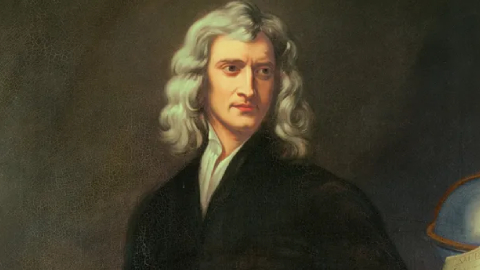
Due to reasons such as financial difficulties, his mother married someone else in 1646, when Isaac was 3 years old. Newton did not live with them; instead, he stayed with his grandmother. When Newton turned 12, his mother returned after the death of her second husband, and Newton inherited a substantial legacy from his stepfather. He began his education at King’s School in Grantham and graduated successfully. However, while his mother wanted Newton to deal with farm work, her son, contrary to what she imagined, had a nature that was constantly looking at the skies, curious about the sky, space, the world, existence, and everything. Eventually, Newton convinced his mother and began his education at Cambridge University.
With his works that would shatter the Aristotelian atmosphere prevailing throughout his education and scientific career, his gravity, differential and integral calculations made during the 2 years he spent at the farm (Annus Mirabilis – Miraculous Years) to get away from London due to the plague epidemic, his discovery of the light spectrum, and the Law of Gravity, he left us a great legacy. During a significant part of being a scientist, he served as a professor of mathematics at Cambridge, was later accepted into the Royal Society, and in his old age, became the Master of the Mint and President of the Royal Society.
Scientific Achievements:
- Mathematics: Differential and Integral Calculus.
- Optics: Discovery of the color spectrum of white light and the invention of the reflecting (Newtonian) telescope.
- Physics: Three Laws of Motion and the Law of Universal Gravitation.
Sir Isaac Newton, who spent his life with achievements, passed away on March 31, 1727.
Private Life
Isaac Newton’s only known relationship was his engagement to Miss Storey, whom he met while staying with a pharmacist family in his youth. Other than this, he never married throughout his life. It is said that Newton remembered Miss Storey until his last moment. The main reason for their separation is thought to be Newton’s extreme intensity of interest in his academic studies.

Hantavirus: Symptoms, Transmission, and Prevention Guide
Meta’s “Token Leaderboard” Drives Employees Crazy: Tens of Thousands of Dollars Wasted Overnight!
Who is Louis Pasteur? The Visionary Who Revolutionized Modern Medicine
Who Invented the Electric Scooter?