

In the AI era, “Token Anxiety” is becoming increasingly absurd. Burning tokens within Meta is no longer just an operation; it has become a KPI.
💡 Who Founded OnlyFans and Its Founding Story
A New Crisis Within Meta: “Claudeonomics” and Token Ranking
According to a report published by The Information, a target-based AI token consumption ranking called “Claudeonomics” (named after Anthropic’s flagship Claude) has emerged within Meta. This list, created voluntarily by employees on the internal network, tracks the token usage of more than 85,000 staff members.
According to the list, the total amount of tokens consumed within Meta in the last 30 days has exceeded 60 trillion. Based on Anthropic’s current pricing (approximately $15 per 1 million tokens for the input and output average of the Claude Opus 4.6 model), it is estimated that the cost of this consumption is around $900 million. Of course, it is not yet known which model Meta actually uses or whether they receive a special discount.
💡 How Cartels Buy Politics in Mexico?
The report states that the individual consuming the most tokens within Meta has reached the 281 billion level. Depending on the type of model, this figure could mean millions of dollars in costs for a single person.
Token Consumption: Silicon Valley’s New Status Symbol
Consuming the most AI computing power (compute) within Meta is turning into a new status symbol. This situation reflects the rising “Token Maximization” culture in Silicon Valley; namely, the tendency to accept token consumption as a metric of productivity and a competitive indicator of how well an employee has mastered AI.
Tech giants also support this trend:
- Nvidia CEO Jensen Huang: In a statement last month, he noted that he would be “deeply concerned” if an engineer earning $500,000 a year spent less than $250,000 a year on AI tokens.
- Meta CTO Andrew Bosworth: At a conference in February, he said that if a senior engineer spent as much money on token purchases as their salary, their productivity could increase tenfold. Bosworth stated, “The result of this process is very clear; investment should continue, there is no upper limit.”
- Andrej Karpathy (Former Tesla and OpenAI scientist): Speaking on a podcast, he summarized this psychology by saying, “I feel anxious if I don’t run out of tokens.”
Structural Change in the Age of Agents: “Digital Lobster” OpenClaw
While Meta’s leaderboard represents the understanding of “more usage = more productivity,” the popularity of tools like OpenClaw reveals another reality: in the era of Agents, the way tokens are consumed is changing structurally.
These “digital lobsters,” constantly trained by developers, are not just chatbots that answer questions; they are Agent systems that continuously execute tasks, call tools autonomously, and break down goals into pieces. These systems do not work in a “one question, one answer” format; once a task begins, it can run in the background for hours, reasoning repeatedly and correcting itself.
The real issue begins here:
- Apparent Convenience: The user no longer has to interact with the AI frequently; the system completes the process itself.
- Hidden Cost: The user bears the computational cost of an entire chain of tasks, not just “a few dialogues.” A simple automation process can turn into hundreds of model calls in the background.
Is Token Consumption Equal to Productivity?
Meta’nın sıralaması ciddi tartışmalara yol açtı. Bloomberg yazarı Joe Weisenthal, X platformunda şu soruyu sordu: “Üretkenliği toplam token tüketimiyle ölçmenin ne anlamı var?” Hatta bu durumu Mao dönemi Çin’inin verimsiz “arka bahçe çelik fırınlarına” benzetti ve sadece sayılara odaklanıp kaliteyi göz ardı etmenin kaynak israfı olduğunu savundu.
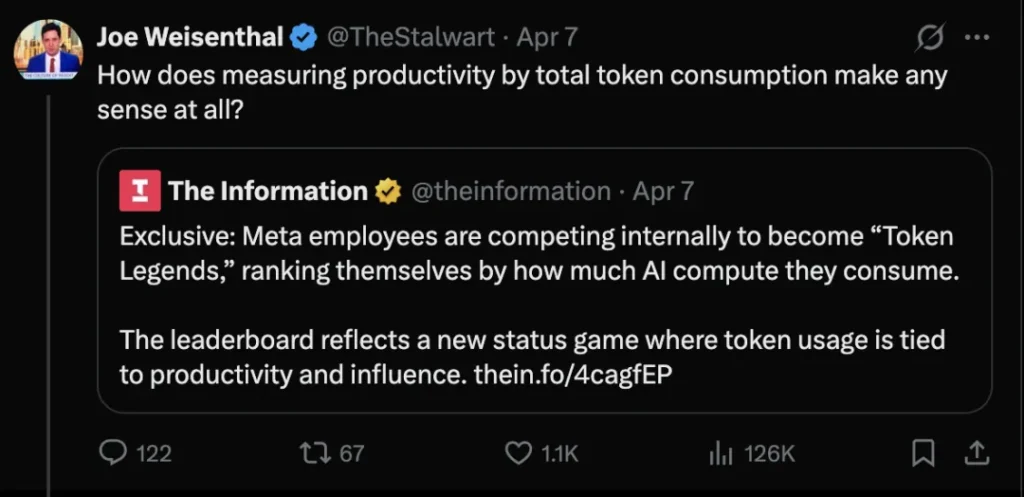
Critical Note: A token is an input indicator, not an output. Just like measuring an employee’s productivity by the “number of pages they had printed,” consuming more tokens does not mean achieving more results.
Behind the Scenes of Inefficiency: Why Are We Spending So Many Tokens?
According to YuanLab.ai experts, the main inefficiency lies in the following points:
- Redundant Content: Some models continue to generate unnecessary content under the name of “self-verification” or “reflection” even after reaching the correct result. In some models, this “unnecessary token” rate is over 70%.
- Latency Loop: As the chain of reasoning lengthens, the response time increases. In Agent systems, the delay of each step excessively extends the total duration, leading to timeouts and retries, which causes more token waste.
Financial Irrationality in AI: The ROI Problem
For example, consider a corporate financial report analysis task:
- Image and text analysis, data extraction, comparison, and report generation process…
- Each step requires independent model calls, and the output of the previous step is added to the next.
- To reduce the margin of error, the system constantly “goes back” and recalculates.
As a result, a single analysis task can consume millions of tokens. In this case, the cost of AI can many times exceed the cost of a human employee doing the same job. In other words, the Return on Investment (ROI) turns out to be negative commercially. In short; the increase in token consumption may reflect the complexity and “inability to simplify” of the system, rather than an increase in production.
Conclusion: The Future is Not in Token Consumption, but in Token Efficiency
The industry is now starting to focus on “how correctly each step is done” rather than “how many steps were taken.” Experts see the excessive token spending of current Agent systems as a “technical compromise.”
Because the model cannot make the right decision in one go, it wastes processing power with constant “thinking” and “verification” steps. This is like an inexperienced intern constantly asking questions and correcting mistakes, whereas a mature expert finishes the job in one go.
In conclusion: The AI race is evolving from the point of “who burns more resources” to “who uses the resources at hand most efficiently.” Discussions like OpenClaw are paving the way for AI to move from being a luxury and expensive toy to a sustainable infrastructure where the value of every single token is known.
The new rule in the token economy is clear: Doing a lot of work with few tokens.



Hantavirus: Symptoms, Transmission, and Prevention Guide
Meta’s “Token Leaderboard” Drives Employees Crazy: Tens of Thousands of Dollars Wasted Overnight!
Who is Louis Pasteur? The Visionary Who Revolutionized Modern Medicine
Who Invented the Electric Scooter?