

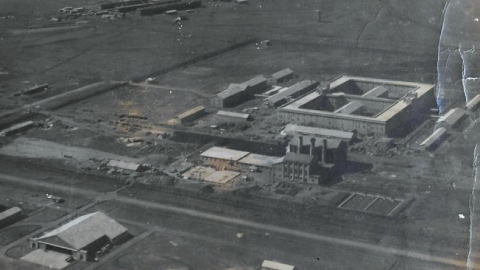
Unit 731 was an institution under the Imperial Japanese Army during World War II that conducted experiments on humans, focusing on biological and chemical research. Officially registered as the “Epidemic Prevention and Water Purification Department” of the Kwantung Army, this institution was essentially under the Kempeitai Military Police of the Japanese Empire. A complete facility was constructed and became active between 1934 and 1939 in the Pingfang District of northeastern China. By 1941, it officially took the name Unit 731.

Unit 731 accelerated its research when General Shiro Ishii, a member of the Kwantung Army, took management, and it remained under Ishii’s administration until the unit’s dissolution. While the exact number of people slaughtered at the facility is unknown, it is estimated to be between 3,000 and 12,000. However, when field attacks such as plague-infected fleas and poisoned water sources released by the unit into Chinese cities are considered, the number of people who lost their lives is thought to be between 200,000 and 500,000. More than half of these victims were captured Chinese people, while the rest consisted mostly of Russians, Koreans, Mongolians, and some Allied prisoners of war. Within the facility, subjects were not referred to as humans but by the code name “Maruta”, meaning “log” in Japanese; this term was used to completely objectify the victims and cover up the atrocities committed. People were subjected to experiments regardless of whether they were soldiers or civilians; men, women, or children. As stated in some Japanese sources, the vast majority of the subjects were brought to the facility by the Kempeitai Military Police.
Some of the experiments conducted on humans since the establishment of the unit are as follows:
- Examination of the subject’s internal organs without anesthesia (Vivisection): Cutting open the bodies of subjects while they were alive and without any narcotics to monitor organ functions.
- Injections of diseases: Injecting various types of viruses, bacteria, and microbes (plague, cholera, anthrax, etc.) to monitor the subject’s disease and death process.
- Freezing experiments: Freezing all or part of the subjects’ bodies (usually arms and legs) and then testing different thawing methods.
- Sexual abuse and disease tests: Use of female prisoners for the purpose of satisfying sexual desires and subsequently forcing them to be infected with venereal diseases such as syphilis to examine their effects on the body.
- Pressure and centrifuge tests: Placing subjects in pressure chambers to measure how much high pressure the human body could withstand, or spinning them in high-speed centrifuges to measure the separation rate of body fluids.
- Biological and chemical weapon tests conducted on all subjects.
With the end of World War II, the facility used by the unit was blown up by the order of General Ishii to destroy evidence. While Ishii and his assistants, who were later captured, were to be tried as war criminals, they accepted the offer of immunity provided by the United States in exchange for the sharing of information obtained from these horrific experiments. In this way, Ishii and his team escaped without any punishment. The responsible parties captured by the Soviet Forces were tried and sentenced to prison terms ranging from 2 to 25 years. The Japanese State has confirmed the existence of Unit 731 but has not accepted the right to individual lawsuits and compensation for the subjects.






Discover Dispatcharr: The Ultimate Open-Source IPTV and EPG Management Powerhouse
What is HAARP? Artificial Earthquakes Tesla’s Mysterious Legacy
Alibaba Issues Notice: Full Ban on All Anthropic Claude Series Models and Claude Code Programming Agent Effective July 10
OpenSquilla 0.4.0 Released: AI Coding Can “Self-Verify” for the First Time