

With tens of thousands of stores in more than 80 countries worldwide, Starbucks is not just a coffee chain today, but also a sociological symbol of modern urban life. However, behind this massive success lies not only caffeine but a meticulously constructed founding vision, the “Third Place” philosophy that fills a social gap, and employee rights models that have revolutionized the business world.
💡Who Invented the Electric Scooter?
1Founding and the Initial Mission: A Long Journey from Bean to Cup
The story of Starbucks, which began in 1971 at Seattle’s Pike Place Market, did not start with the idea of selling coffee in paper cups, contrary to popular belief. The primary goal of founders Jerry Baldwin, Gordon Bowker, and Zev Siegl was to introduce Americans to “real coffee.” Unlike the low-quality, powdered coffees sold in tin cans that dominated the US market at the time, the founders focused on roasting and selling high-quality Arabica coffee beans.
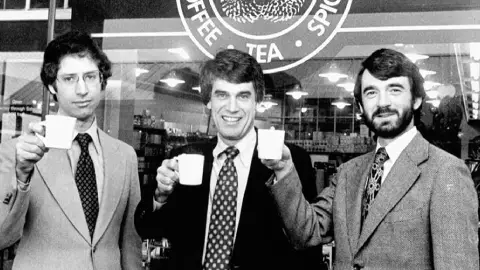
Alfred Peet, the owner of Peet’s Coffee & Tea in Berkeley, was a major influence in shaping this mission. The founders learned the art of quality coffee from Peet, and Starbucks even sourced its beans from him during its first year. For the first ten years, Starbucks was a small shop selling only bean coffee and coffee brewing equipment, with no seating area. The vision of offering coffee as an “experience,” which began with Howard Schultz’s trip to Italy in 1983, was initially rejected by the founders; this led Schultz to found his own company, Il Giornale, and later purchase Starbucks to merge these two concepts.
The “Third Place” Concept
The most critical strategic move that allowed Starbucks to transform into a global empire is the “Third Place” concept. Inspired by the theory of sociologist Ray Oldenburg, this concept defines a neutral, safe, and comfortable space between an individual’s home (the first place) and workplace (the second place) where people can socialize, read, or work.
Starbucks stores are specifically designed to bring this concept to life. The wooden textures used in the interior, soft lighting, jazz music playing in the background, and the personal dialogues baristas establish with customers are all parts of this atmosphere. As emphasized in Taylor Clark’s analyses, Starbucks markets the experience of a “living room away from home” rather than just coffee. This space became so effective that, as Paul Copan noted, it began to function as a new generation “marketplace” (agora) where deep topics such as ethics, philosophy, and religion are discussed in modern society.
Employee Rights and Social Responsibility: The “People First” Principle
The fundamental feature that distinguishes Starbucks from many other retail giants is that it places the concept of “partner” instead of “employee” at the center of its corporate culture. This approach, shaped by the lessons Howard Schultz learned from the insecurity his father faced after a work accident, has played a key role in the brand’s success.
The most striking data is that Starbucks offers comprehensive health insurance and stock options to all its employees in the US (including part-time staff working only 20 hours a week). As highlighted in John Simmons’ study, the amount Starbucks spends on health insurance for its employees is more than the amount it pays for its primary raw material, coffee beans. Acting with the principle of “people before beans,” the company discovered the direct link between low staff turnover and high customer satisfaction. Additionally, through fair prices paid to farmers and Fair Trade practices, it has woven social responsibility into the brand’s DNA within the coffee supply chain.
Bibliography
- Starbucked: A Double Tall Tale of Caffeine, Commerce, and Culture – Taylor Clark
- The Starbucks Story: How The Brand Changed The World – John Simmons
- When God Goes to Starbucks: A Guide to Everyday Apologetics – Paul Copan





Discover Dispatcharr: The Ultimate Open-Source IPTV and EPG Management Powerhouse
What is HAARP? Artificial Earthquakes Tesla’s Mysterious Legacy
Alibaba Issues Notice: Full Ban on All Anthropic Claude Series Models and Claude Code Programming Agent Effective July 10
OpenSquilla 0.4.0 Released: AI Coding Can “Self-Verify” for the First Time