

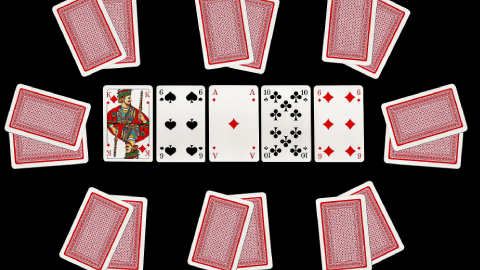
I know you have searched the internet a lot for the answer to this cliché question. I also know you couldn’t find it. Because there is no detailed information about the origin of poker anywhere except for French and English sources. As the “Kimkurdu” editors, we are honored to give you the answer to this question.
Different Views on the Origin of Poker
When we examine the history of poker, we see that the origins of such card games are specific to the region of China and Central Asia around the 9th century. Although not known exactly, it is thought that Poker is a derivative of the “As Nas” game played in Persia since the 17th century.
It is believed that card games, thought to have passed from Persians to the French through diplomatic relations and trade, were spread to America by the French, and it is known that the modern form of Poker was first played in New Orleans. It is known that Poker, played at that time with 20 cards and shared as 5 cards per person, has been played in American nightlife and at tables with alcohol since the 1800s. This initial 20-card system began to become insufficient as it spread via riverboats, and a transition to the 52-card deck was made starting from the 1830s. With this change, new strategic depths like the “Flush” hand were added to the game.
David Parlett’s research has shown that Poker actually has very tight connections with European-origin games. This is because Poker is called “Poque” in France, “Poca” in Ireland, and “Pochen” in Germany. While the German word “Pochen” means “to knock” or “to challenge,” pointing to the game’s betting raising logic; according to another view, the origin of the word is based on the word “Poke,” a slang term used by pickpockets for the act of deception. This means it is likely that poker, a game that could jump quickly to neighboring nations, came from these European roots.
Unlike the classical school, modern school historians do not adopt an ancient period examination regarding the history of Poker and reject this view. According to them, the development of this game should be understood by looking at the origin of today’s 52-card version. They claim that all betting games have similar systematics and find it quite normal for Poker to have this mathematics as well. According to them, this game first emerged in the 1800s around the Mississippi River in America.
The Spread of Poker in America
Behind the spread of the game across the entire American continent lies the American Civil War. This game, played by Northern and Southern soldiers to pass time in camps, reached every corner as soldiers returned to their hometowns after the war. During the Wild West period, poker turned into a true legend; the pair of Aces and pair of 8s held by the famous gunslinger Wild Bill Hickok when he was shot in the back and killed in 1876 has been engraved in poker history as the “Dead Man’s Hand.”
Poker Types
Today, when poker is mentioned, it does not refer to a single game but to different types of games. Among the best-known poker varieties are Texas Hold’em, Omaha, Seven Card Stud, and Five Card Draw. Each type has its own unique strategy, hand structure, and gameplay logic.
While Texas Hold’em stands out as the most popular poker type today, Omaha creates a different tactical depth as it offers more card options. Seven Card Stud is known as one of the types representing the old-period poker culture. Five Card Draw reflects the more classic and simple face of poker.
Poker Terms and Psychological Depth
Poker has not remained just a card game; over time, it has created its own language and culture. Terms such as “Bluff,” “raise,” “all-in,” and “flush” have become concepts recognized even in daily language. Especially “bluffing” is one of the most important elements showing that poker is based not only on luck but also on psychology. The term “bluff” is etymologically based on the Dutch word “verbluffen” (to surprise or daze).
Additionally, poker is accepted as a behavioral science. Physical clues called “Tells”—such as pupil dilation, changes in tone of voice, or trembling hands—constitute the strategic depth of the game.
Cultural Impact and Cinema
The cultural impact of poker has not remained only at the tables. Poker has always held a strong place in movies, novels, and popular culture. From Wild West movies to big city casinos, poker has been a game identified with risk, intelligence, composure, and strategy. Especially productions like “Rounders” (1998), which reflects the modern poker world, and “Casino Royale,” which hosts James Bond’s prestigious scenes, have increased the popularity of the game.
The Rise of Texas Hold’em and the Mathematical Dimension
Texas Hold’em, the most popular type in today’s world, was born in the town of Robstown, Texas, in the early 1900s. It reached its current massive industrial dimensions through tournaments in Las Vegas in the 1900s, followed by the online gaming revolution.
The mathematical dimension of the game led John von Neumann, the founder of modern “Game Theory,” to be inspired by poker while developing his strategies. Today, the fact that artificial intelligence programs like “Libratus” and “Pluribus” defeat the world’s best players has proven how complex a mathematical structure the game possesses.
Frequently Asked Questions
- What is the strongest hand in poker? The strongest hand is the Royal Flush.
- Is poker a game of luck? Poker is a game of skill weighted by strategy and mathematics.
Conclusion When the history of poker is examined, it is seen that this game was not invented by a single person all at once, but reached its current state through the combination of different cultures, different periods, and different gaming traditions. Today, poker continues to be one of the most remarkable card games in the world with both its historical roots and its strategic structure.


Discover Dispatcharr: The Ultimate Open-Source IPTV and EPG Management Powerhouse
What is HAARP? Artificial Earthquakes Tesla’s Mysterious Legacy
Alibaba Issues Notice: Full Ban on All Anthropic Claude Series Models and Claude Code Programming Agent Effective July 10
OpenSquilla 0.4.0 Released: AI Coding Can “Self-Verify” for the First Time